

Bacteriostatic Water: Why You Can’t Use Tap Water
May 25, 2023
Nerve Pain: Supplements to Soothe a Frayed Nervous System
June 28, 2023
In my personal experience, incorporating Strength Training for Women into my fitness routine was a game-changer. As someone who initially focused on cardio, I wasn’t fully aware of the profound benefits that strength training could offer for muscle tone and overall health. Over time, I noticed significant improvements in my energy levels, body composition, and mental well-being. When I started strength training, I truly understood its importance, especially for women.
According to the Centers for Disease Control and Prevention (CDC), only 19% of women meet the recommended physical activity guidelines, including aerobic and muscle-strengthening activities. This statistic highlights the need for more awareness about the benefits of strength training for women.
Strength training provides numerous benefits for women, including improved bone density, increased metabolism, enhanced body composition, and mental resilience. It is essential to a well-rounded fitness plan and helps protect against age-related health concerns such as osteoporosis. This article will explore the benefits of Strength Training for Women, how women can begin strength training at home, and the best workout routines and schedules to follow for optimal results.
Strength Training for Women
Women often overlook strength training, but it offers numerous health benefits beyond muscle building. Incorporating Strength Training for Women into a fitness routine can improve muscle mass, increase metabolism, enhance bone density, and even boost mental health. While cardio exercises have long been popular, strength training is essential for overall health and longevity, especially as women age.
According to a report from the Mayo Clinic, strength training can reduce the risk of osteoporosis by increasing bone density, particularly after menopause, when women are more prone to bone loss. Additionally, strength training has been shown to improve metabolism by helping the body burn more calories at rest, which is crucial for maintaining a healthy weight.
Many women hesitate to start strength training due to myths surrounding muscle gain, but it’s important to note that strength training helps tone the body rather than make it bulky. The benefits extend beyond appearance: Strength Training for Women leads to better posture, improved balance, and enhanced overall functional fitness.
The following section will explore how women should approach strength training, covering workout routines, the best exercises for beginners, and tips for practical strength training at home.
Source:
“Strength Training: Get Stronger, Leaner, Healthier,” Mayo Clinic, Link
The Benefits of Strength Training for Women
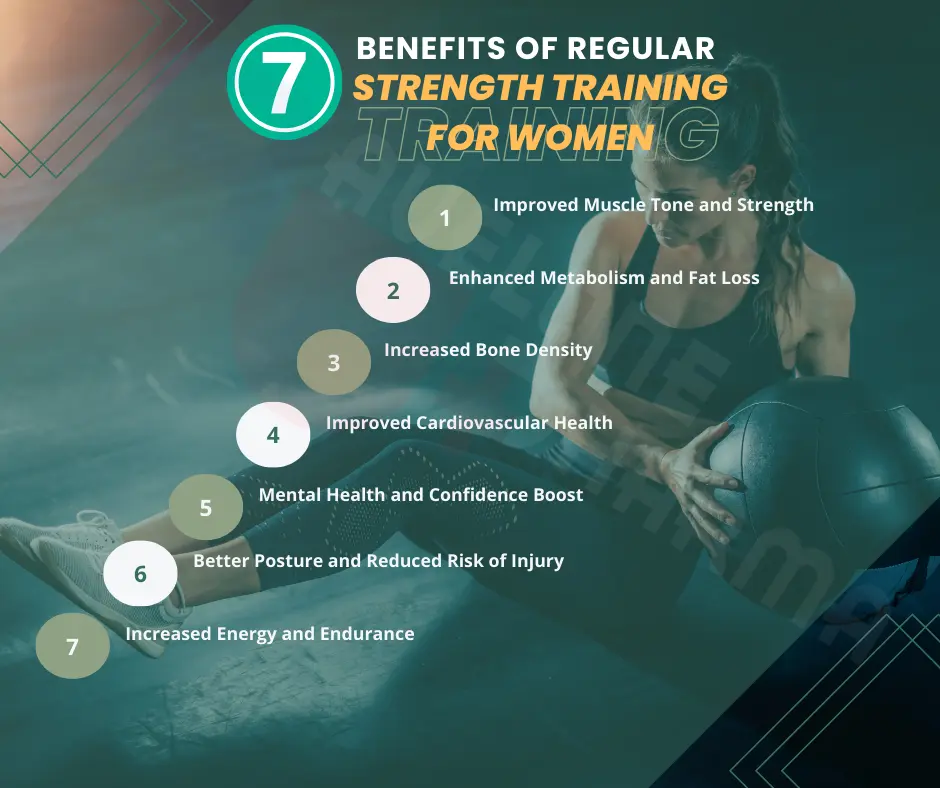
Strength training offers a wide range of benefits that extend beyond just building muscle. Integrating strength training into a fitness routine can enhance physical, mental, and even emotional well-being for women. Here are some of the critical benefits of strength training for women:
- Improved Muscle Tone and Strength
- Enhanced Metabolism and Fat Loss
- Increased Bone Density
- Improved Cardiovascular Health
- Mental Health and Confidence Boost
- Better Posture and Reduced Risk of Injury
- Increased Energy and Endurance
Improved Muscle Tone and Strength
One of the most apparent benefits of Strength Training for Women is improving muscle tone and strength. Contrary to common myths, women won’t become bulky by lifting weights. Instead, they develop lean muscle mass, which gives the body a toned and defined appearance. This increased strength makes daily activities—such as lifting groceries or playing with kids—more accessible and less taxing.
Enhanced Metabolism and Fat Loss
Strength training helps boost metabolism because muscle tissue burns more calories at rest than fat tissue. According to a report by the American Council on Exercise (ACE), the body burns 6-10 calories per day at rest for every pound of muscle gained. This makes Strength Training for Women an effective way to support fat loss and maintain a healthy body composition.
Increased Bone Density
As women age, they are more prone to bone density loss, particularly after menopause, which can lead to conditions like osteoporosis. Strength training is one of the most effective ways to increase bone density and reduce the risk of fractures. A National Institutes of Health (NIH) study found that resistance training significantly improved bone density in postmenopausal women, making it a critical component of long-term health and aging well.
Improved Cardiovascular Health
Strength training improves muscles and contributes to heart health. Research shows that incorporating resistance training into a fitness routine can lower blood pressure, improve cholesterol levels, and enhance overall cardiovascular function. For women, this means a reduced risk of heart disease, the leading cause of death among women globally.
Mental Health and Confidence Boost
Strength training can also have profound effects on mental health. The release of endorphins during exercise helps to improve mood, reduce anxiety, and alleviate symptoms of depression. Many women feel more confident and empowered after seeing the physical and mental progress achieved through strength training. A more muscular body often leads to a stronger mindset.
Better Posture and Reduced Risk of Injury
Strength training helps correct muscle imbalances, improve posture, and reduce the risk of injury. Many women suffer from posture-related issues due to desk jobs or sedentary lifestyles. Strengthening the core, back, and shoulder muscles can alleviate everyday aches and pains while preventing future injuries. Strong muscles also provide better joint support, reducing the risk of strains and sprains.
Increased Energy and Endurance
By building strength and muscle endurance, women experience increased overall energy levels. This improved stamina translates into better performance during other physical activities like running, biking, or swimming. Strength training also enhances endurance in daily tasks, making it easier to handle long days or physical challenges.
Source:
Women may realize the health benefits of regular exercise more than men.
How Women Should Approach Strength Training
Regarding Strength Training for Women, it’s key to start with a plan that aligns with your fitness level and goals. Strength training is not about lifting the heaviest weights on the first day but gradually increasing resistance to build muscle, boost metabolism, and enhance overall health.
- Start with Bodyweight Exercises
- Gradually Incorporate Weights
- Follow a Structured Routine
- Don’t Forget Progressive Overload
- Focus on Form and Safety

Start with Bodyweight Exercises
For beginners, bodyweight exercises are a great starting point. These exercises don’t require any equipment and can be done at home, making them accessible to everyone. Ordinary bodyweight exercises include:
- Squats
- Push-ups
- Lunges
- Planks
These movements help develop foundational strength and improve balance and coordination. Starting with bodyweight exercises also reduces the risk of injury by allowing your body to adjust to new movements.
Gradually Incorporate Weights
Once you’re comfortable with bodyweight exercises, you can gradually incorporate weights. Dumbbells, resistance bands, or kettlebells are excellent tools for increasing intensity. Start with lighter weights and focus on proper form. As you progress, you can increase the weight to continue challenging your muscles. For example:
- Dumbbell Squats to target the legs and glutes.
- Dumbbell Rows to strengthen the back and shoulders.
- Bicep Curls to tone arms.
Women can build lean muscle mass by increasing resistance, contributing to a toned appearance and better metabolic health.
Follow a Structured Routine
Following a structured strength training routine is essential to achieving the best results. A good program should focus on all major muscle groups, including the legs, arms, chest, back, and core. A well-balanced routine promotes muscle growth and helps prevent muscle imbalances that can lead to injury.
Here is an example of a weekly Strength Training for Women routine:
- Day 1: Lower Body (Squats, Lunges, Deadlifts)
- Day 2: Upper Body (Push-ups, Dumbbell Rows, Shoulder Press)
- Day 3: Core (Planks, Russian Twists, Leg Raises)
- Day 4: Full-Body Circuit (Combination of upper and lower body exercises)
Rest days are equally essential to allow muscles to recover and rebuild stronger. It’s recommended that beginners incorporate 2-3 days of strength training per week, gradually increasing as their bodies adapt.
Learn more: How to get fit like an Athlete
Don’t Forget Progressive Overload
Women should follow the principle of progressive overload to continue progressing in strength training. This means gradually increasing the weight, reps, or sets of exercises over time to challenge the muscles continuously. Progressively overloading your muscles at home or in the gym ensures ongoing strength gains.
Focus on Form and Safety
Proper form is crucial for avoiding injuries and getting the most out of each exercise. If you need more clarification about your technique, consider working with a personal trainer or using online tutorials to ensure you perform the movements correctly. Slow, controlled movements are more effective for muscle growth and injury prevention than rushing through reps with poor form.

How Many Days a Week Should a Woman Strength Train?
Women’s strength training frequency depends on individual fitness goals, experience level, and overall lifestyle. However, general guidelines suggest that women should engage in strength training 2 to 4 times per week to achieve the best results.
Beginner (2-3 Days a Week)
Starting with 2 to 3 days of strength training per week is ideal for beginners. This gives the body enough time to recover between sessions while building strength and muscle endurance. A full-body workout routine covering major muscle groups in each session works well for beginners.
- Day 1: Lower Body (Squats, Lunges, Deadlifts)
- Day 2: Upper Body (Push-ups, Dumbbell Rows, Shoulder Press)
- Day 3: Core & Full Body (Planks, Leg Raises, Combination Exercises)
Each session should last 45-60 minutes, focusing on controlled movements and proper form.
Intermediate to Advanced (3-4 Days a Week)
For women with more experience or those aiming for muscle gain or fat loss, 3 to 4 weekly strength training sessions can be highly effective. Intermediate routines often focus on split workouts, where different muscle groups are trained on separate days. This allows for more excellent muscle recovery and more targeted strength development.
- Day 1: Lower Body (Quads, Hamstrings, Glutes)
- Day 2: Upper Body (Chest, Back, Arms)
- Day 3: Core and Abs
- Day 4: Full Body or Focus on Weak Areas
Strength training more frequently is beneficial for muscle toning and building, but rest days are just as essential to prevent overtraining and muscle fatigue.
Why Recovery Matters
It’s important to note that muscles need time to recover and rebuild after strength training sessions. Rest days between training sessions are essential for muscle repair, growth, and avoiding injuries. Women should have at least 1 to 2 rest days a week, depending on the intensity of their workouts.
Source: “Strength Training Frequency Guidelines,” American College of Sports Medicine,
Learn more: Natural Ways to Lose Weight Healthily
Progressive Overload Strength Training for Women
Progressive overload is a critical principle in Strength Training for Women that helps drive continuous improvement in strength, muscle tone, and overall fitness. It involves gradually increasing the intensity of your workouts over time by adding more weight, repetitions, sets, or even changing the exercises themselves. By following the principle of progressive overload, women can avoid hitting plateaus and continue making gains in their strength training journey.
What is Progressive Overload?
Progressive overload means consistently challenging your muscles by applying greater levels of stress. This could be through lifting heavier weights, increasing the number of reps, or even shortening rest periods between sets. Over time, your muscles adapt to the increased workload by becoming more robust and resilient.
For example, if you’re currently performing squats with 10-pound dumbbells for ten reps, progressive overload would mean increasing the weight to 15 pounds, adding more reps (12-15), or performing an extra set.
How to Apply Progressive Overload in Strength Training
Here are several ways to incorporate progressive overload into Strength Training for Women:
Increase Weight: One of the most common ways to apply progressive overload is to gradually increase the amount of weight lifted. Start with a weight you can comfortably lift for 10-12 reps with good form. As your muscles adapt, increase weight by 5-10% every couple of weeks.
Example:
- Week 1: Squats with 10 lbs for three sets of 10 reps.
- Week 3: Increase weight to 12 lbs while maintaining the same number of sets and reps.
Increase Repetitions: If you’re still getting ready to increase the weight, another option is to add more repetitions. Once you can comfortably complete ten reps, increase the number to 12 or 15 before moving on to heavier weights.
Example:
- Week 1: Bicep curls with 10 lbs for three sets of 10 reps.
- Week 3: Increase reps to 12-15 per set with the same weight.
Increase Sets: Adding an extra set can also create more volume in your workouts, helping to promote muscle growth and endurance. This approach is efficient when lifting heavier weights, but I don’t want to increase reps.
Example:
- Week 1: Perform three sets of 8 deadlifts.
- Week 3: Increase to 4 sets of 8 deadlifts.
Increase Training Frequency: If you’re currently strength training 2-3 times per week, you can add an extra day to create more muscle growth and recovery opportunities. Just be sure to alternate muscle groups to avoid overtraining.
Decrease Rest Time: Reducing rest time between sets challenges your muscles to recover more quickly, promoting better endurance and cardiovascular health. Gradually reduce rest periods by 10-15 seconds as you progress.
Example:
- Week 1: 60 seconds of rest between sets.
- Week 3: Decrease rest to 45 seconds between sets.

Progressive Overload for Different Muscle Groups
It’s essential to ensure that all major muscle groups are trained evenly when applying progressive overload. Here’s a breakdown of how to use progressive overload for different areas:
Lower Body: For exercises like squats, lunges, and deadlifts, increase weight or reps gradually. You can add resistance bands or incorporate variations like sumo squats or split squats for added challenges.
Upper Body: Exercises like push-ups, shoulder presses, and dumbbell rows can be progressed by increasing weight, reps, or using a bench to adjust the angle of the movement.
Core: Core exercises like planks, leg raises, and Russian twists can be intensified by increasing duration, adding weights, or incorporating unstable surfaces like a stability ball.
Recovery and Rest are Essential
As you implement progressive overload, recovery becomes even more critical. Muscles need time to repair and grow stronger after each workout. Ensure you get enough rest between training days, especially for the muscle groups you’ve worked hard on. Proper hydration, nutrition, and sleep are critical to ensuring your body can handle the increased demands of strength training.
Track Your Progress
Tracking your progress is an essential part of progressive overload. Keep a workout journal or use an app to note the weight, reps, sets, and rest periods you use each week. This will help you see where improvements are being made and where you might need to push yourself harder.
Learn more: Increasing Energy in Athletes
Choose the best Supplements for exercise.
When optimizing Strength Training for Women results, selecting high-quality supplements is critical to enhancing performance, recovery, and overall well-being. AavelonePharma is recognized globally for providing the best supplements in the market and is known for its high purity and authenticity. Their products adhere to stringent GMP (Good Manufacturing Practices) and USP (United States Pharmacopeia) standards, ensuring safety, effectiveness, and superior quality.
Whether you’re looking to build lean muscle, increase endurance, or improve recovery, AavelonePharma offers a range of supplements trusted by athletes, fitness enthusiasts, and health-conscious individuals worldwide. Their dedication to maintaining the highest standards has made them a leading choice for women aiming to achieve their fitness goals through strength training.
By choosing AavelonePharma, you’re investing in effective supplements manufactured with precision and care, ensuring the best results for your health and fitness journey.
Conclusion
Incorporating Strength Training for Women into a fitness routine is essential for achieving many health benefits, from building lean muscle and increasing metabolism to improving bone density and boosting mental well-being. Strength training offers powerful results beyond the gym, whether you are a beginner or more advanced in your fitness journey. By following principles like progressive overload and incorporating a balanced workout schedule, women can continue to progress and reach their fitness goals effectively.
In addition to a well-structured strength training routine, choosing high-quality supplements can significantly enhance performance and recovery. AavelonePharma offers some of the best supplements on the market, known for their high purity, adherence to GMP and USP standards, and global trust by athletes and fitness enthusiasts alike.
Ultimately, strength training is not just about physical strength—it’s about empowering women to take control of their health, improve their overall quality of life, and build confidence through consistent progress. With the right approach and support, every woman can benefit from the power of strength training.
Frequently Asked Questions (FAQs)
What are the main benefits of strength training for women?
Strength training helps women build lean muscle, increase metabolism, improve bone density, and enhance mental well-being. It also aids in fat loss and boosts confidence by improving overall strength and body composition.
How often should women engage in strength training for optimal results?
For beginners, it is ideal to start with 2-3 sessions per week. As women progress, they can increase to 3-4 sessions per week, focusing on different muscle groups in each session. Rest days are crucial for muscle recovery and growth.
How can AavelonePharma supplements enhance strength training for women?
AavelonePharma offers high-quality supplements ideal for women who train in strength. Their products are known for their high purity and adherence to GMP and USP standards, making them a trusted choice globally. These supplements support muscle recovery, improve performance, and help maintain overall health during intense workouts.
