
The “Glass Skin” Protocol: GHK-Cu and Collagen
May 22, 2023
The Importance of Strength Training for Women
June 4, 2023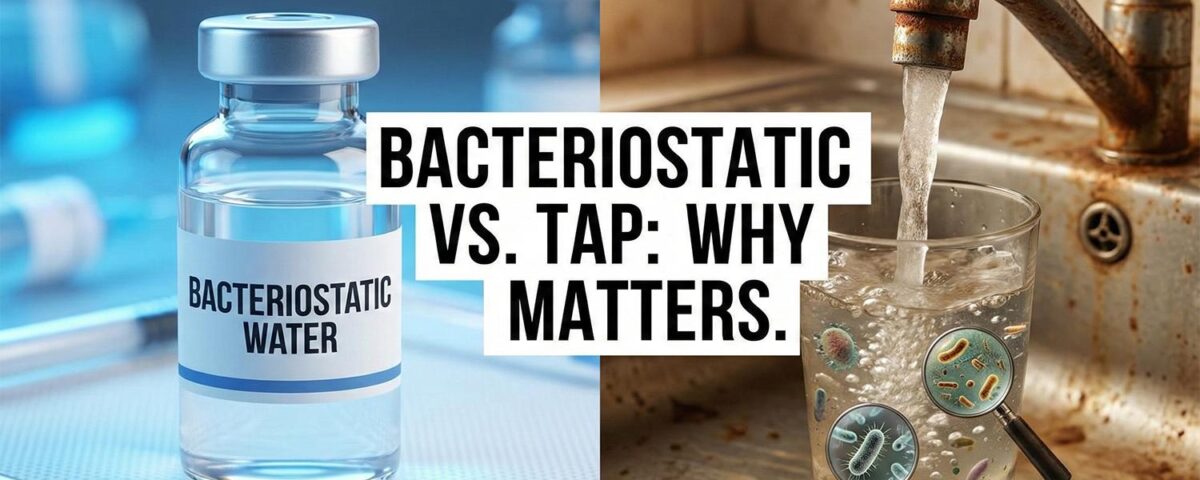
In the world of peptide therapy and self-administered injectables, the focus is almost always on the active compound. People spend hours researching the dosage of BPC-157 or the timing of their HCG. Yet, they often treat the most critical component of the process as an afterthought: The Solvent.
A common—and dangerous—question often arises on forums: “Can I just use tap water or bottled water to mix my peptides?”
The answer is a definitive, non-negotiable NO.
Injecting a solution mixed with tap water, or even standard bottled water, is a direct route to severe infection, tissue necrosis, or sepsis. When you bypass the body’s natural defense barriers (skin and stomach acid) via injection, sterility is not optional; it is survival. This article explains exactly what Bacteriostatic Water is, why it is chemically unique, and why it is the only safe choice for reconstitution.
The Chemistry: What is Bacteriostatic Water?
Bacteriostatic Water (often shortened to “Bac Water”) is not just “clean water.” It is a specific pharmaceutical preparation designed for multi-dose injections.
It consists of two ingredients:
- Sterile Water for Injection (USP): Water that has been filtered and distilled to remove all microorganisms, heavy metals, and pyrogens (fever-inducing substances).
- 0.9% Benzyl Alcohol: This is the magic ingredient. Benzyl alcohol acts as a bacteriostatic preservative.
How Benzyl Alcohol Works
The term “bacteriostatic” means “stopping bacteria.” It doesn’t necessarily kill all bacteria instantly (that would be bactericidal), but it creates an environment where bacteria cannot reproduce.
When you insert a needle into a vial to draw out a dose, you inevitably introduce a tiny amount of contaminants from the air or the needle tip. Without Benzyl Alcohol, those few bacteria would multiply exponentially in the water over 24 hours. With Benzyl Alcohol, they are halted, keeping the solution safe for up to 28 days.
The Danger of Tap and Bottled Water
Why is tap water lethal when injected? Tap water is treated to be safe for drinking, not injecting. Your stomach contains hydrochloric acid (pH 1.5–3.5), which kills most pathogens found in tap water. Your bloodstream does not have this defense.
Tap water contains:
- Bacteria & Protozoa: E. coli, Giardia, and Legionella are often present in trace amounts harmless to the gut but disastrous to the blood.
- Minerals & Chemicals: Chlorine, fluoride, and heavy metals can cause painful inflammation (phlebitis) and tissue damage when injected directly into muscle or fat.
- Pyrogens: Dead bacterial fragments that trigger an immediate, violent immune response (fever, chills, shock).
The Result: Injecting tap water can lead to an abscess (a pocket of pus requiring surgical drainage), cellulitis (spreading skin infection), or sepsis (a life-threatening blood infection).
Bacteriostatic vs. Sterile Water: Know the Difference
Another common mistake is confusing “Sterile Water” with “Bacteriostatic Water.” They are not the same.
| Feature | Bacteriostatic Water | Sterile Water for Injection |
|---|---|---|
| Additives | Contains 0.9% Benzyl Alcohol | No additives (Pure H2O) |
| Usage | Multi-dose vials (used over days/weeks) | Single-dose only (use immediately) |
| Shelf Life (Open) | 28 Days | Zero (Must discard after opening) |
Critical Takeaway: Most peptides (like BPC-157 or Melanotan) are sold in multi-dose vials. You reconstitute the powder and then draw from that vial daily for 2-4 weeks. Therefore, you MUST use Bacteriostatic Water. If you use plain Sterile Water, bacteria will begin growing in the vial the moment you puncture it, making it unsafe by day 2.
Proper Storage and Handling
Even with the right water, user error can compromise sterility.
The 28-Day Rule
Once you open a bottle of Bacteriostatic Water (puncture the stopper), the clock starts. The preservative power of benzyl alcohol is only guaranteed for 28 days. After this window, the preservative degrades, and plastic leaching can occur.
Refrigeration
While the water itself is shelf-stable, once you mix it with a peptide, the peptide usually requires refrigeration. The cold temperature also slows bacterial growth, adding a secondary layer of protection.
Don’t “Double Dip”
Never re-use a syringe to draw water. Use a fresh, sterile needle every single time you enter the water vial or the peptide vial. A “clean looking” needle is covered in microscopic bacteria from your skin.
If you are exploring peptide therapy, ensuring you have the correct supplies is just as important as buying high-purity compounds. For a full range of research peptides that require proper reconstitution, visit our Peptides Category.
Troubleshooting: “Why Does It Sting?”
A common complaint with Bacteriostatic Water is a slight stinging sensation upon injection. This is due to the Benzyl Alcohol.
This is normal and usually mild. However, if the pain is severe, it could indicate:
- pH Imbalance: The peptide itself may be acidic.
- Alcohol Sensitivity: You may be sensitive to the preservative.
- Wrong Solvent: Some compounds are not water-soluble and require acetic acid or oil. Always check the solubility data for your specific compound.
Conclusion
Reconstituting peptides is a simple process, but it requires pharmaceutical-grade respect. You are performing a medical procedure on yourself.
Tap water is for drinking. Sterile water is for single use. Bacteriostatic water is the standard for peptide therapy. Do not cut corners to save a few dollars on water; the cost of treating an infection is infinitely higher. Stay sterile, stay safe, and respect the needle.
