

Lidocaine Allergies: Signs You Should Watch For
March 13, 2023
The Role of Antioxidants in Enhancing Athletic Performance
March 30, 2023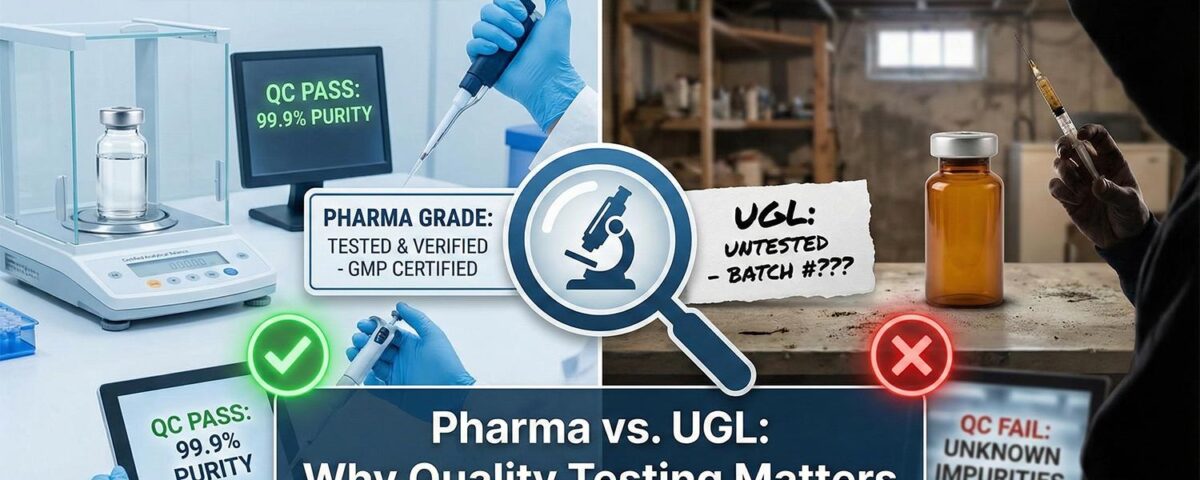
In the world of performance enhancement and metabolic optimization, there is a constant debate that usually comes down to one factor: Price vs. Safety.
On one side, you have legitimate Pharma Grade products—manufactured in regulated facilities, tested rigorously, and priced to reflect that quality. On the other side, you have UGLs (Underground Labs)—unregulated entities offering products at a fraction of the cost.
For the end user, the temptation to save money is high. However, recent analysis from 2024 and 2025 has exposed a darker reality behind the UGL market: widespread heavy metal contamination, chronic under-dosing, and unsterile production environments. This article breaks down the manufacturing differences you cannot see with the naked eye and explains why third-party quality testing is non-negotiable for your health.
Defining the Contenders
What is “Pharma Grade”?
Pharma Grade refers to products manufactured in a facility that adheres to Good Manufacturing Practices (GMP). These facilities are audited by government bodies (like the FDA or EMA). Every step, from raw material sourcing to the final seal on the vial, is documented and tested.
What is a UGL (Underground Lab)?
A UGL is an unregulated producer. While some “top-tier” UGLs operate with a degree of professionalism, the vast majority range from a rented room with a pill press to a literal bathtub setup. There is no oversight, no accountability, and rarely any legitimate testing equipment.
The Manufacturing Gap: It’s More Than Just Potency
Most users focus solely on milligram strength (e.g., “Is this really 250mg/ml?”). While potency is important, the real danger lies in the process.
1. The Sterility Chain
Pharma Grade: Production happens in ISO-certified clean rooms with HEPA air filtration to remove microscopic particles. Vials are washed and depyrogenated (treated to remove fever-causing bacterial byproducts) before filling.
UGL: Often produced in residential kitchens or dusty warehouses. Sterilization usually relies on simple syringe filters (0.22 micron) which can easily fail or be bypassed to speed up production. The air is not filtered, meaning dust, pet dander, and airborne bacteria can settle into the open oil before it is capped.
2. The “Heavy Metal” Problem
This is the most overlooked risk. A 2025 study analyzing seized UGL products found alarming levels of Lead, Arsenic, and Cadmium.
- Source: These metals typically come from low-quality raw powders (API) sourced from unregulated chemical factories in Asia that use dirty industrial solvents.
- Risk: Unlike bacteria, you cannot “filter out” heavy metals. They accumulate in your liver, kidneys, and brain over time, leading to toxicity that mimics chronic disease.
3. Excipients and Carrier Oils
Pharmaceutical products use medical-grade carrier oils (like Castor or MCT) and precise ratios of solvents like Benzyl Alcohol (BA) and Benzyl Benzoate (BB). UGLs often use supermarket-grade oils (grapeseed, cottonseed) which may contain allergens, or excessive amounts of solvents to prevent the gear from “crashing,” leading to severe Post-Injection Pain (PIP) and inflammation.
Why Quality Testing is Non-Negotiable
At Aavelone Pharma, we believe that blind trust is dangerous. Transparency is the only currency that matters. Here is how rigorous testing separates the professional from the amateur.
High-Performance Liquid Chromatography (HPLC)
HPLC is the gold standard for verifying that a product contains exactly what the label claims. It separates the components of a mixture to identify and quantify the active ingredient.
- The UGL Reality: Many UGLs claim to test, but they often “cherry-pick” a perfect batch to send to a lab, or worse, Photoshop reports.
- The Pharma Standard: Testing is done on random samples from every batch, ensuring consistency across the board.
Microbiological Assay
Potency means nothing if the product gives you an infection. Microbiological testing incubates samples to see if bacteria or fungi grow. If a single colony appears, the entire batch must be discarded. In the UGL world, a contaminated batch is often sold anyway to avoid losing profit.
Expert Note: In the community, independent testing services like Janoshik Analytical have become vital for exposing UGLs that under-dose or sell bunk gear. We support this culture of verification—if a supplier isn’t willing to prove their quality, they don’t deserve your business.
The Economics of Safety
Why is Pharma Grade more expensive? You are paying for the compliance costs that keep you safe:
- Sanitation: Maintaining clean rooms costs thousands per month.
- Waste: Discarding batches that test 98% purity instead of 99.9%.
- Testing: Running comprehensive HPLC and Mass Spectrometry on every lot.
When you buy a cheap UGL vial for $30, you aren’t getting a bargain; you are gambling that the brewer didn’t sneeze into the batch or use a rusted vat to mix the raw powder.
Conclusion: Health is the Investment
If you are committed to optimizing your longevity and performance, putting unknown substances into your body is counterproductive. The inflammation caused by heavy metals and dirty carrier oils can negate the benefits of the therapy itself.
Whether you are seeking metabolic support or anti-aging protocols, always demand HPLC-verified, Pharma Grade quality. Your long-term health is worth the premium.
Ensure your regimen is built on a foundation of purity. Explore our rigorously tested Metabolic Health solutions or browse our Anti-Aging category for products you can trust.
