

Sleep Hygiene: The Foundation of Immunity and Recovery
July 25, 2022
what is The best drug to increase performance in athletes
August 9, 2022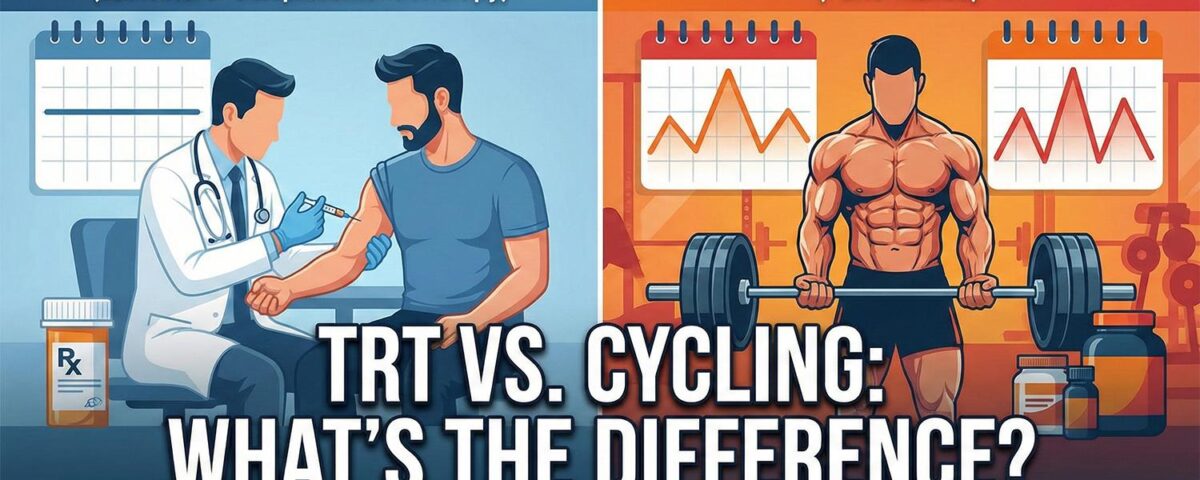
In the world of men’s health and performance enhancement, the terminology can be confusing. You often hear about “TRT clinics” in one breath and “bodybuilding cycles” in the next. Since both often involve the exact same compound—synthetic testosterone—it is easy to assume they are the same thing.
They are not.
While the vial might look the same, the intent, dosage, duration, and physiological impact are vastly different. Confusing the two can lead to disappointed expectations at best, and significant health risks at worst.
Whether you are a man over 40 suffering from low energy or an athlete looking to push past genetic limits, understanding the distinction between Testosterone Replacement Therapy (TRT) and Cycling is the first step toward safe usage. This guide breaks down the medical and practical differences between these two protocols.
1. The Intent: Restoration vs. Enhancement
The primary difference lies in the goal.
What is TRT? (Medical Restoration)
TRT (Testosterone Replacement Therapy) is a medical intervention designed to treat Hypogonadism (clinically low testosterone). The goal is not to give you “superpowers,” but to restore you to a normal physiological range.
- The Baseline: A healthy male produces between 300 to 1,000 ng/dL of testosterone naturally.
- The TRT Goal: To keep your levels stable in the upper-normal range (e.g., 800–1100 ng/dL) year-round to eliminate symptoms like brain fog, low libido, and lethargy.
What is Cycling? (Performance Enhancement)
Cycling is the recreational use of hormones to achieve supraphysiological levels—levels far beyond what the human body can produce naturally.
- The Goal: Rapid muscle hypertrophy (growth), strength gains, and cosmetic changes that are impossible naturally.
- The Levels: A cycle might push testosterone levels to 2,500 ng/dL, 4,000 ng/dL, or even higher depending on the compounds used.
2. The Dosage Difference
This is where the line is drawn in the sand. Dosage dictates toxicity.
Typical TRT Protocol:
A standard TRT dose is usually between 100mg to 200mg per week of Testosterone Cypionate or Enanthate. This amount mimics natural production closely enough to resolve symptoms without placing excessive strain on the organs.
Typical Cycling Protocol:
A beginner cycle often starts at 500mg per week. Advanced bodybuilders may push this to 1,000mg+ and “stack” other compounds (like Anavar, Deca Durabolin, or Trenbolone) on top. At these doses, the body is flooded with hormones, leading to rapid anabolic changes but also triggering more severe side effects.
Looking for pharmaceutical-grade support? Explore our Men’s Health & Testosterone category for products manufactured to strict quality standards.
3. Duration: “For Life” vs. “For Now”
TRT is a Marriage
TRT is generally considered a lifelong commitment. When you introduce exogenous testosterone, your body’s HPTA (Hypothalamic-Pituitary-Gonadal Axis) shuts down its own production. If you stop TRT, your natural levels will likely crash back to their previous low baseline—or lower.
Cycling is a Vacation
A “cycle” is finite, typically lasting 12 to 16 weeks. The user blasts the body with high doses to grow, then stops. The period after the cycle is crucial.
- PCT (Post Cycle Therapy): Because the high doses have shut down natural production completely, the user must take medications (like SERMs or HCG) to jumpstart their own system again.
- Time Off: The general rule is “time on = time off” to allow health markers (cholesterol, liver enzymes) to recover.
Planning a recovery phase? Browse our Post Cycle Therapy (PCT) solutions to ensure a smooth transition and hormonal recovery.
4. The Grey Area: “Blast and Cruise”
In modern bodybuilding, the line has blurred with a method known as Blast and Cruise. This is where users stop doing traditional “cycles” involving PCT and instead switch between high doses and TRT doses.
- The Blast: 12-16 weeks of high dosages for muscle gain.
- The Cruise: Dropping down to a TRT dose (150mg/week) to maintain muscle mass and allow health markers to stabilize without crashing hormonal levels completely.
Note: While this avoids the hormonal crash of PCT, it means the user is effectively on TRT for life and will likely face permanent fertility issues without intervention (like HCG).
5. Side Effect Profiles
Because the dosages differ, the risks differ significantly.
TRT Risks (Manageable)
At physiological doses, side effects are usually mild and manageable with routine blood work:
- Hematocrit: Slight thickening of the blood (necessitating blood donation).
- Acne: Mild breakouts due to hormonal fluctuation.
- Estrogen Management: Some men convert testosterone to estrogen faster, requiring minor adjustments.
Cycling Risks (Severe)
At supraphysiological doses, the risks compound:
- Cardiovascular Strain: High doses can crush HDL (good cholesterol) and raise LDL (bad cholesterol), increasing plaque buildup.
- Left Ventricular Hypertrophy: Thickening of the heart muscle walls.
- Gynecomastia: High testosterone converts to high estrogen, leading to breast tissue development if not managed with Aromatase Inhibitors (AIs).
- Cosmetic Issues: Severe acne, accelerated male pattern baldness (if prone).
6. Summary Comparison Table
Here is the breakdown at a glance:
| Feature | TRT (Therapy) | Cycling (Performance) |
|---|---|---|
| Primary Goal | Normalcy & Health | Maximal Muscle & Strength |
| Typical Dosage | 100mg – 200mg / week | 500mg+ / week |
| Duration | Indefinite (Lifelong) | 12-16 Weeks (Temporary) |
| Blood Levels | 800 – 1,200 ng/dL | 2,500 – 5,000+ ng/dL |
| Recovery | None needed (continuous) | Requires aggressive PCT |
Conclusion: Know Your “Why”
The choice between TRT and Cycling comes down to your objectives. Are you trying to fix a broken engine, or are you trying to put a Ferrari engine into a Honda Civic?
If you are suffering from legitimate hypogonadism, TRT provides a stable, healthy path to reclaiming your vitality. If you are an athlete choosing to cycle, you must accept that you are trading long-term health risks for short-term performance gains.
Regardless of the path, blood work is non-negotiable. You cannot manage what you do not measure. Before starting any hormonal protocol, ensure you have a baseline of your lipids, liver enzymes, and hormonal panel.
Ensure your protocol is built on quality. Visit Aavelone Pharma for Pharma-Grade Testosterone and PCT Support products verified by HPLC testing.
