

Female Libido: Understanding Hormonal Support for Women
May 5, 2024
What happens if you consume vitamin E regularly?
June 5, 2024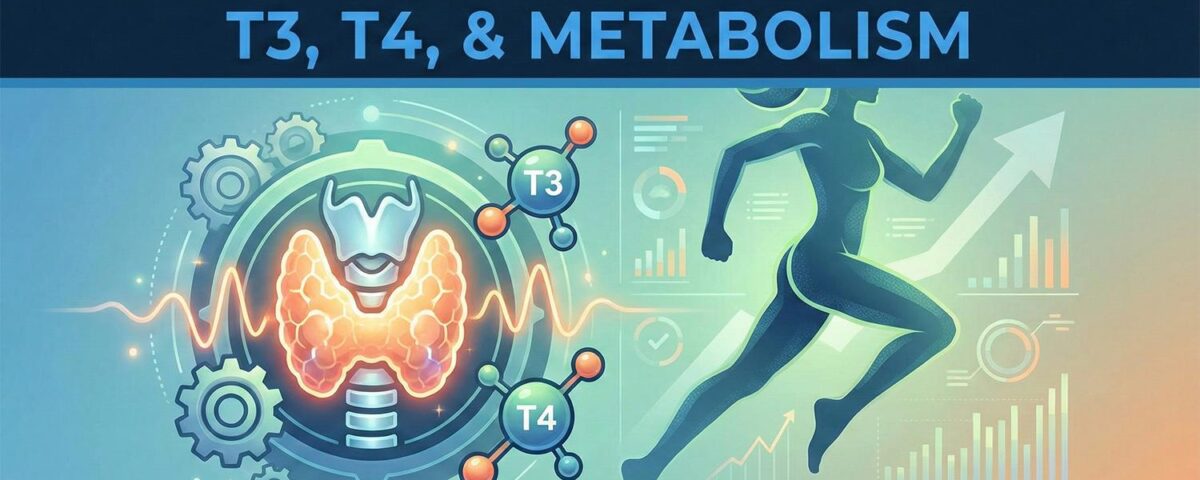
You’re eating clean. You’re training hard. You’re sleeping (mostly) well. Yet, the scale won’t budge, your energy is flat, and you feel perpetually cold. If this sounds familiar, you may be the victim of a “normal” thyroid test.
The thyroid gland is the body’s master thermostat. It dictates how fast every cell in your body burns energy. When it is sluggish, your metabolic rate crashes. While millions of people are diagnosed with Hypothyroidism, millions more exist in a grey area: their lab results fall within the “reference range,” but their metabolism is functionally broken.
True thyroid optimization requires looking under the hood. It requires understanding the critical difference between the storage hormone (T4) and the active fuel (T3). This guide explores the biochemistry of your metabolism and how to optimize it for peak performance and fat loss.
The Mechanics: How the Thyroid Works (The HPT Axis)
To optimize your thyroid, you must first understand the signal chain known as the Hypothalamic-Pituitary-Thyroid (HPT) Axis.
- The Brain Calls for Energy: Your Hypothalamus detects low levels of hormones and signals the Pituitary gland.
- The Signal (TSH): The Pituitary releases TSH (Thyroid Stimulating Hormone). Think of TSH as the foot on the gas pedal—it screams at the thyroid to work harder.
- The Output (T4): The Thyroid gland responds by producing mostly Thyroxine (T4).
Here is the catch: T4 is biologically inactive. It does not boost metabolism. It is merely a storage vessel. For you to feel energetic and burn fat, T4 must be converted into Triiodothyronine (T3).
T4 vs. T3: The Storage vs. The Fire
This distinction is where most treatments fail. Standard medicine often treats thyroid issues by prescribing T4 (Levothyroxine) and walking away. But if your body cannot convert that T4 into T3, your blood levels will look fine, but your symptoms will remain.
- T4 (Thyroxine): The pro-hormone. It has a long half-life (about 5-7 days) and circulates in the blood waiting to be used.
- T3 (Triiodothyronine): The active hormone. It is roughly 4 to 5 times more potent than T4. T3 is what actually binds to receptors in your cells to increase ATP production, burn fat, and regulate body temperature.
The Optimization Goal: You don’t just want a healthy thyroid; you want efficient conversion. You want to ensure the T4 in your system is actually becoming T3.
The “Conversion Problem”: Why You Can’t Lose Weight
If you have high T4 but low T3, you have a conversion problem. This conversion happens primarily in the liver (60%) and the gut (20%). Several factors can block this process, acting as a metabolic brake.
1. Stress and Cortisol
Chronic stress triggers the production of cortisol. High cortisol inhibits the enzyme (5′-deiodinase) responsible for turning T4 into T3. Instead, it shunts T4 into a useless molecule called Reverse T3 (rT3).
Reverse T3 acts like a key that fits in the ignition but won’t turn. It blocks the receptor so real T3 cannot get in. The result? You feel hypothyroid even if your T4 levels are normal.
2. Nutrient Deficiencies
The conversion enzyme is selenium-dependent. Zinc is also critical for T3 receptor sensitivity. Without these co-factors, the conversion machinery stalls.
3. Liver Congestion
Since the majority of conversion happens in the liver, conditions like Fatty Liver Disease or excessive alcohol consumption can severely hamper metabolic rate.
Suspect your metabolism is stalling? Explore our Metabolic Health & Fat Loss solutions designed to support optimal energy expenditure.
The “TSH Trap”: Why Your Doctor Says You Are Fine
Most general practitioners only test TSH. If your TSH is within the reference range (usually 0.5 to 4.5 mIU/L), they declare you “healthy.”
However, TSH is a lagging indicator. It reflects what your brain thinks, not what your cells are receiving. You can have normal TSH but clinically low Free T3. To truly assess thyroid health, you need a full panel:
- TSH: The brain’s signal.
- Free T4: The available storage.
- Free T3: The available active fuel (The most important metric for fat loss).
- Reverse T3: The metabolic brake.
- Thyroid Antibodies (TPO & TgAb): To rule out autoimmune Hashimoto’s disease.
Optimizing With Pharmaceuticals: T3 and T4 Protocols
For those diagnosed with hypothyroidism or athletes looking to optimize metabolic rate during a cutting phase, pharmaceutical intervention is often necessary. There are three main approaches:
1. T4 Monotherapy (Levothyroxine)
The standard of care. It works well if you are a good converter. If you take T4 and still feel tired, you likely need to add T3.
2. T3 Monotherapy (Liothyronine/Cytomel)
Often used by bodybuilders or those with “thyroid resistance.” Because T3 has a very short half-life (hours), it hits the system fast and spikes metabolism quickly.
Risk: It requires precise dosing (often multiple times a day) to avoid heart palpitations or muscle loss.
3. Combination Therapy (T4 + T3)
This mimics the body’s natural production (which is roughly 90% T4 and 10% T3). This can be achieved by stacking synthetic T4 and T3 or using Natural Desiccated Thyroid (NDT).
Supplements and Lifestyle for Conversion
Whether you are on medication or trying to boost natural levels, you must support the conversion pathway.
- Selenium (200mcg/day): The fuel for the deiodinase enzyme. Brazil nuts are a natural source.
- Zinc: Supports the conversion and immune function.
- Ashwagandha: An adaptogen shown in studies to normalize TSH and lower cortisol, effectively “unblocking” the conversion pathway.
- Guggulsterones: An herbal compound that may stimulate the thyroid to absorb more iodine.
A Note on Iodine: While the thyroid needs iodine, supplementing with high doses can be dangerous if you have autoimmune thyroid issues (Hashimoto’s). Always test antibodies before loading iodine.
Looking to support your hormonal baseline? Browse our General Health & Wellness category for high-quality co-factors and adaptogens.
Conclusion: Treat the Patient, Not the Paper
Thyroid optimization is not about forcing a number on a lab report into a specific box. It is about how you feel and perform. If you are struggling with cold extremities, brain fog, and stubborn body fat, your T3 levels may be suboptimal regardless of what your TSH says.
By focusing on liver health, stress management, and ensuring optimal T4 to T3 conversion, you can reignite your metabolic engine and achieve the body composition you work so hard for.
