

Introducing New Sports medicine and Their Benefits
January 31, 2025
Respiratory Health for Athletes: Increasing Oxygen Uptake (VO2 Max)
April 3, 2025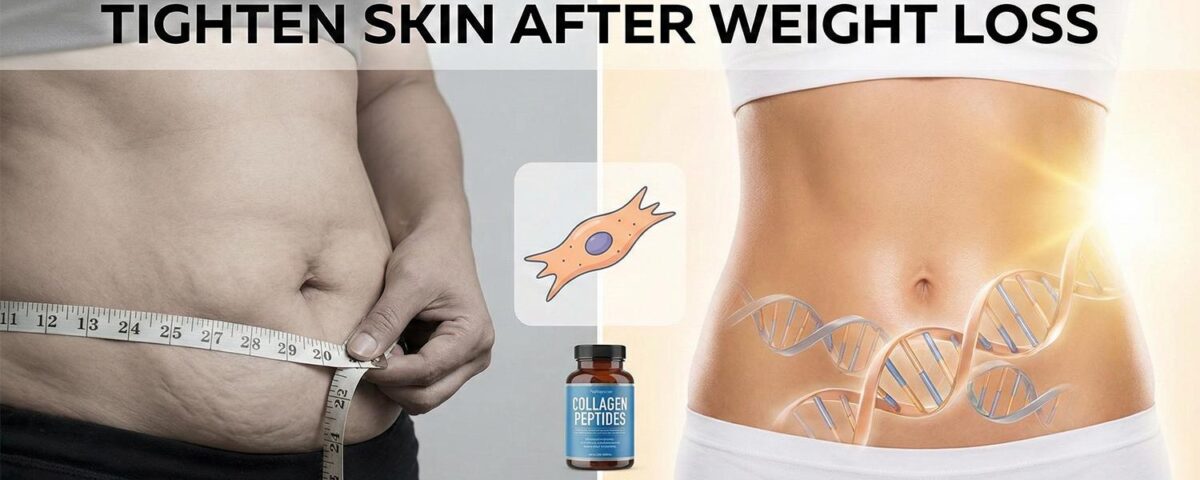
Losing a significant amount of weight is a monumental achievement. It requires discipline, metabolic adaptation, and mental fortitude. However, for many, the victory lap is cut short by an unexpected and disheartening side effect: loose skin.
When the fat disappears, the skin that once covered it doesn’t always snap back. It hangs, folds, and obscures the muscle definition you worked so hard to reveal. The standard advice—”just give it time” or “drink more water”—is often insufficient for significant weight loss cases.
To truly address loose skin, we must stop treating it as a cosmetic issue and start treating it as a connective tissue issue. The solution lies in maximizing Collagen Synthesis—the biological process of rebuilding the structural scaffolding of your body. This article explores the science of elasticity, the role of autophagy, and the advanced protocols to tighten your physique.
The Anatomy of the Sag: Why Skin Doesn’t “Snap Back”
Skin is not an inert sheet of plastic; it is a living organ. Its structure is maintained by the **Extracellular Matrix (ECM)**, which consists primarily of two proteins:
- Collagen: Provides structure and firmness (tensile strength).
- Elastin: Provides the ability to stretch and recoil (elasticity).
When you gain weight, the skin expands to accommodate the new mass. If this expansion persists for years, the collagen fibers become damaged, and the elastin fibers lose their “snap.” When you lose weight rapidly, the underlying support structure (fat) is removed faster than the skin can shrink, resulting in the dreaded “deflated balloon” effect.
To fix this, we must stimulate the Fibroblasts—the cells responsible for producing new collagen and elastin.
Mechanism 1: Nutritional Signaling (The Raw Materials)
You cannot build a house without bricks. To synthesize collagen, your body requires specific amino acids and co-factors. Taking a generic multivitamin is not enough.
Hydrolyzed Collagen Peptides
While controversial in the past, recent clinical data suggests that consuming Hydrolyzed Collagen (broken down into small peptides) does more than just provide protein. It acts as a signaling molecule. The presence of these peptide fragments in the bloodstream tricks the body into thinking tissue damage has occurred, triggering a repair response in the skin.
The Vitamin C Cofactor
Collagen synthesis is chemically impossible without Vitamin C. It is the enzyme cofactor required to link collagen fibers together (hydroxylation). Without adequate Vitamin C, new collagen is weak and unstable.
Protocol: 10g–20g of Collagen Peptides combined with 500mg–1000mg of Vitamin C daily.
Mechanism 2: Autophagy (Taking Out the Trash)
One of the most overlooked mechanisms for skin tightening is Autophagy. This is the body’s cellular recycling process. During states of low energy intake (fasting), cells identify damaged or unnecessary components (like excess loose skin cells) and break them down for energy.
Research suggests that Intermittent Fasting or periodic prolonged fasts can upregulate autophagy, potentially aiding the body in metabolizing excess skin tissue. This is why individuals who lose weight via fasting often report less loose skin than those who use standard caloric restriction.
For those managing a weight loss phase, integrating metabolic strategies that support autophagy is key. Explore our Metabolic Health & Weight Loss category for tools to optimize this process.
Mechanism 3: Advanced Peptide Therapy
If you are looking for a more direct pharmaceutical intervention, Signal Peptides are the frontier of skin regeneration.
GHK-Cu (Copper Peptide)
GHK-Cu is the gold standard for skin remodeling. It is a naturally occurring copper complex that declines with age. It works by resetting the DNA of fibroblasts to a younger state.
The Benefits:
- Stimulates the breakdown of old, damaged collagen (scar tissue).
- Triggers the production of new, healthy collagen and elastin.
- Increases skin density and thickness.
GHK-Cu can be applied topically or administered systematically for a more potent effect. It is widely regarded as one of the few compounds capable of actually tightening skin rather than just hydrating it.
To learn more about regenerative compounds like GHK-Cu, visit our Peptides Category.
Mechanical Stimulation: Microneedling
To force the skin to tighten, you sometimes have to injure it—in a controlled manner. Microneedling involves creating thousands of microscopic punctures in the dermis.
This physical trauma triggers an immediate wound-healing cascade. The body rushes to repair the “holes” by laying down fresh collagen and elastin fibers. Over several sessions, this can significantly thicken and tighten the skin, especially when combined with topical GHK-Cu or serum.
Managing Expectations: The Role of Surgery
We must be realistic. There is a physiological limit to how much skin can shrink naturally.
- Mild to Moderate Loose Skin: Highly responsive to collagen protocols, autophagy, and hypertrophy (building muscle to fill the void).
- Severe Loose Skin (100lbs+ loss): While skin quality can improve, the structural damage may be irreversible without surgical intervention (abdominoplasty or brachioplasty).
However, even if surgery is in your future, following a collagen synthesis protocol before surgery ensures your skin quality is at its peak, leading to better surgical outcomes and faster scarring recovery.
Conclusion
Loose skin is a battle scar of your transformation, but it doesn’t have to be permanent. By understanding the biology of the extracellular matrix, you can move beyond hope and start employing strategy.
Focus on the “Three Pillars of Tightening”: Feed the fibroblasts (Collagen/Vitamin C), Signal the repair (GHK-Cu/Peptides), and Recycle the waste (Autophagy). Your skin is living tissue—give it the right instructions, and it will respond.
